Friday, May 20, 2022

what is seo?


What Is SEO?

SEO stands for search engine optimization. SEO is the process of taking steps to help a website or piece of content rank higher on Google.

The key difference between SEO and paid advertising is that SEO involves “organic” ranking, which means you don’t pay to be in that space. To make it a bit simpler, search engine optimization means taking a piece of online content and optimizing it so search engines like Google show it towards the top of the page when someone searches for something.

Look at it this way. When someone types “vegan lasagna” into Google, they’re likely looking for a recipe, ingredients, and instructions on how to make it. If you wrote an article about making vegan lasagna, you’d want people to find your recipe. For anyone to find it, you need to rank above all the other websites with recipes for vegan lasagna. It’s not easy, but that’s what SEO marketing is all about.

Let’s break it down even further: The majority of online searches begin with a search engine like Google. In fact, 75 percent of those searches start on Google.

To better understand how you can rank your content higher in the search engines, you need to first understand how search works.

The ultimate goal of this article is to help you understand the ins and outs of search so you can optimize your content to rank higher on Google and get more eyeballs on your posts.

Core Elements of SEO: On-Page SEO and Off-Page SEO

When it comes to broader SEO, there are two equally important paths: on-page SEO and off-page SEO. 

On-page SEO is about building content to improve your rankings. This comes down to incorporating keywords into your pages and content, writing high-quality content regularly, making sure your metatags and titles are keyword-rich and well-written, among other factors.

Off-page SEO is the optimization happening off of your website itself, such as earning backlinks. This part of the equation involves building relationships and creating content people want to share. Though it takes a lot of legwork, it’s integral to SEO success. 

SEO Strategies: Black Hat Vs. White Hat

I’ve always played the long-term entrepreneurial game, and I believe it’s the way to go. However, this isn’t the case with everyone. Some people would rather take the quick gains and move onto something else.

When it comes to SEO, going for quick gains is often referred to as “black hat SEO.” People who implement black hat SEO tend to use sneaky tactics like keyword stuffing and link scraping to rank quickly. It might work for the short-term and get you some traffic to your site, but after a while, Google ends up penalizing and even blacklisting your site so you’ll never rank.

On the other hand, white hat SEO is the way to build a sustainable online business. If you do SEO this way, you’ll focus on your human audience.

You’ll try to give them the best content possible and make it easily accessible by playing according to the search engine’s rules.
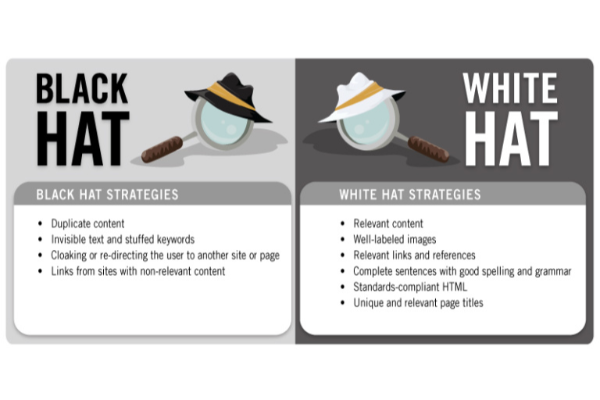
seo marketing - black hat vs white hat

This image from Inbound Marketing Inc. does an exceptional job of breaking it down, but let me shine some additional light on these topics:

  • Duplicate content: When someone tries to rank for a certain keyword, they might duplicate content on their site to try and get that keyword in their text over and over again. Google penalizes sites that do this.
  • Invisible text and keyword stuffing: Years ago, a black hat strategy was to include a ton of keywords at the bottom of your articles but make them the same color as the background. This strategy will get you blacklisted very quickly. The same goes for stuffing in keywords where they don’t belong.
  • Cloaking and redirecting: When it comes to redirects, there’s a right and wrong way to do it. The wrong way is buying up a bunch of keyword-rich domains and directing all the traffic to a single site.
  • Poor linking practices: Going out and purchasing a Fiverr package promising you 5,000 links in 24 hours is not the right way to build links. You need to get links from relevant content and sites in your niche that have their own traffic.

Since Google penalizes sites that do these things, you’ll only hear me talk about white hat SEO.

There is such a thing as gray hat SEO, though. That means it’s not as pure or innocent as the whitest of white hats, but it isn’t quite as egregiously manipulative as black hat techniques can be. You’re not trying to trick anyone or intentionally game the system with gray hat. However, you are trying to get a distinct advantage.

See, Google’s standards aren’t as clear-cut as they’d like you to believe. Many times, they might even say contradictory things. For example, Google has said they’re not a fan of guest blogging to build links.

Now, what about guest blogging to grow your brand? What if you do it to build awareness, generate high-quality traffic back to your site, and become a household name in the industry?

In the SEO world, it’s not so much about what you do but how you do it. If you’re purchasing guest posts on sites that have nothing to do with your niche and spamming a bunch of links, you’re going to get penalized. If you’re creating unique guest posts that provide value to readers on sites that are relevant to you, you’ll be fine, and the link juice will flow nicely to your site.

difference between blogger and wordpress?

 Blogger and WordPress are two such very famous and widely used platforms which basically serves as a pedestal for these creative people to connect and share their views and opinions across the internet, and also to deliver this content to anyone who is interested in such relevant topics.

Blogger vs WordPress

The main difference between Blogger and WordPress is that Blogger is mostly a platform with low customization options, best suited for beginners and WordPress is a more powerful, customizable tool, better suited for people with experience.

Comparison Table between Blogger and WordPress

Parameters of ComparisonBloggerWordPress
DefinitionBlogger is a blogging site that has a simple interface and usually requires no prerequisite knowledge to use.WordPress too is a site for blogging and content generation which does require some prerequisite knowledge and is more complex than Blogger.
Parent CompanyThe parent company of Blogger is Google.WordPress is owned and operated by Automattic.
PriceBlogger is free.WordPress is free for blogging, however, one needs a web host, which costs money.
CustomizationBlogger offers low customizability options.WordPress has high customizability options.
SEO optionsBlogger has no SEO (Search Engine Optimization) tools whatsoever.One can use free SEO plugins and tools in WordPress. There are paid options too.

What is Blogger?

Blogger is a web-based blogging platform that is based in America. Initially, it was developed by Pyra Labs, however, in the year 2003, Google purchased it, and has belonged to the company since then. One big drawback of Blogger is that all the content generated by a blogger is hosted on Google’s server and anyone does not get the option of a custom domain name. The content is accessed under the subdomain of blogspot.com. The biggest drawback of having things stored on Google’s server means that the company might make any change to the content without needing the approval of the user. 

Initially, when Blogger had started out, Pyra Labs had used to charge money for a few features present on the site. However, under the acquisition by Google, this thing changed and all features of this site became free, which led to a wider number of people joining in to post ideas and thoughts out into the internet. In 2004, Google had acquired Picasa and integrated its photo-sharing utility into Blogger. This acquisition and integration made it possible for users to now post photos in Blogger. That which now seems like a very basic activity was a very big feature back in those days.

It was in 2006 when there was a major redesigning of Blogger and all the blogs associated with any Google account were transferred to the Google servers. Google had said that this step would lead to better ease of use because the quality of the servers used now was significantly better. The very useful ‘Draft’ feature was also introduced in the same year itself, which helps the user save an unpublished blog for later editing. Slowly and slowly we can notice that the platform was building up to become a modern content creation platform.

What is WordPress?

WordPress is a web-based content creation and management system that first appeared in the year 2003. It was developed by Matt Mullenweg and Mike Little. It was created by the efforts of creating a fork of b2. It was one of Mike’s friends, Christine Selleck Teremoulet, who has suggested the name WordPress. Since then, the company has boomed a lot, and now enjoys some of the highest market shares in its industry. 

WordPress has a high amount of customizability and options that are usually not found in many other blogging or content management sites. There are certain features that make WordPress really excellent. The major highlights among them being themes, plugins, accessibility, etc. Every WordPress user is allowed to apply various themes on their page, which gives the users a certain control over the way their pages look. Plugins extend the features and functions of the webpage and bring about more third party changes to them, thus loading them with more features. One of the best examples of plugin functionality is SEO, which is really important in this day and age of fierce competition.

Main Differences Between Blogger and WordPress

  1. The main difference between Blogger and WordPress is that Blogger is a blogging site that has a simple interface and usually requires no prerequisite knowledge to use, while WordPress too is a site for blogging and content generation which does require some prerequisite knowledge and is more complex than Blogger.
  2. Blogger is owned by Google, while WordPress is owned by Automattic.
  3. Blogger is free, while you need to pay money to use a web host in WordPress.
  4. Blogger has really low customization options, while WordPress is highly customizable.
  5. Blogger has no SEO options, while there are plugins for SEO in WordPress.

what is digital marketing?

 The term digital marketing refers to the use of digital channels to market products and services in order to reach consumers. This type of marketing involves the use of websites, mobile devices, social media, search engines, and other similar channels. Digital marketing became popular with the advent of the internet in the 1990s.

Digital marketing involves some of the same principles as traditional marketing and is often considered a new way for companies to approach consumers and understand their behavior. Companies often combine traditional and digital marketing techniques in their strategies.

types of digital marketing

Website Marketing

A website is the centerpiece of all digital marketing activities. It is a very powerful channel on its own, but it’s also the medium needed to execute a variety of online marketing campaigns. A website should represent a brand, product, and service in a clear and memorable way. It should be fast, mobile-friendly, and easy to use.

Pay-Per-Click (PPC) Advertising

Pay-per-click (PPC) advertising enables marketers to reach Internet users on a number of digital platforms through paid ads. Marketers can set up PPC campaigns on Google, Bing, LinkedIn, Twitter, Pinterest, or Meta (formerly Facebook) and show their ads to people searching for terms related to the products or services.

PPC campaigns can segment users based on their demographic characteristics (such as by age or gender), or even target their particular interests or location. The most popular PPC platforms are Google Ads and Meta Ads.

Content Marketing

The goal of content marketing is to reach potential customers through the use of content. Content is usually published on a website and then promoted through social media, email marketing, search engine optimization, or even PPC campaigns. The tools of content marketing include blogs, ebooks, online courses, infographics, podcasts, and webinars.

Email Marketing

Email marketing is still one of the most effective digital marketing channels. Many people confuse email marketing with spam email messages, but that’s not what email marketing is all about. This type of marketing allows companies to get in touch with potential customers and anyone interested in their brands.

Many digital marketers use all other digital marketing channels to add leads to their email lists and then, through email marketing, they create customer acquisition funnels to turn those leads into customers.

Social Media Marketing

The primary goal of a social media marketing campaign is brand awareness and establishing social trust. As you go deeper into social media marketing, you can use it to get leads or even as a direct sales channel. Promoted posts and tweets are two examples of social media marketing.

Affiliate Marketing

Affiliate marketing is one of the oldest forms of marketing, and the internet has brought new life to this old standby. With affiliate marketing, influencers promote other people’s products and get a commission every time a sale is made or a lead is introduced. Many well-known companies like Amazon have affiliate programs that pay out millions of dollars per month to websites that sell their products.

Video Marketing

YouTube is one of the most popular search engines in the world. A lot of users are turning to YouTube before making a buying decision, to learn something, read a review, or just to relax.

There are several video marketing platforms, including Facebook Videos, Instagram, and even TikTok to use to run a video marketing campaign. Companies find the most success with video by integrating it with SEO, content marketing, and broader social media marketing campaigns.

SMS Messaging

Companies and nonprofit organizations also use SMS or text messages to send information about their latest promotions or give opportunities to willing customers. Political candidates running for office also use SMS message campaigns to spread positive information about their own platforms. As technology has advanced, many text-to-give campaigns also allow customers to directly pay or give via a simple text message.